Filling in a form
The other day I had give a statement to the police, (nothing serious, I was a witness … see An attempted robbery), and I had to fill in a form. Fortunately, a young policewoman was delegated to help me. She asked me questions, I answered, and she typed the information onto the form. I also had an interpreter with me in case they asked me complicated questions in convoluted Russian, or (more likely), she couldn’t understand my “pigeon Russian”. As it happens the main problems turned out to be much more basic.
For example, “Name?“: I thought that was no problem, and I gave her my business card which has my name in both English and Russian, so that she could get the spelling right. However, I should have known better … and should expected the supplementary question, “Otchestvo?“.
In Russian everyone has three names:
- a Given name – which, when I grew up, was always referred to as a “Christian” name, (in my case: Ian)
- a Patronymic – taken from their father’s name … for men it ends in “vich”, (such as Robertovich), and for women in “vna”, (such as Ivanovna)
- a Family name – or “surname”, (in my case: Claytor)
Sometimes this results in interesting situations like Vladimir Vladimirovich Putin … It is very rare for someone to be addressed just by their given name, (only close friends and family use just the given name), or by the given name and the family name and the polite form of address is to use the given name followed by the patronymic, so Vladimir Putin would be referred to or addressed as Vladimir Vladimirovich, and I would be Ian Robertovich.
When I said that I didn’t have one, she got quite concerned … there is a space for it on the form, so it has to be filled. She looked perplexed and then, speaking slowly and precisely, as if she had recognised that I was obviously mentally deficient – a ‘slow’ foreigner, she asked me what was my father’s name. I was tempted to opt for the simple life and tell her that I was Ian Robertovich, (it wouldn’t have been the first time). However, as the ‘otchestvo’ doesn’t appear on my passport, I anticipated further difficulties in the future and so both I, and my interpreter, tried to explain that, in Britain, we don’t use an ‘otchestvo’. She finally accepted, although she shook her head a little.
Then there was the question was, “Nationality?“. I replied “British” … but she wasn’t happy with that. “No, no,” she said, “that’s your citizenship – you’re a British citizen, you have a British passport – but what is your Nationality?”
Kyrgyz passports, as in most former Soviet republics, record a person’s Nationality … Russian, Kyrgyz, etc.
Here in Kyrgyzstan, the term “nationality” does not necessarily mean what we might take it to mean in the West. Although one definition of the term might refer to “the country, or state, to which a person belongs – either from birth or as a result of naturalization”, there is a wider sense in which the word can be used: “identifying the group of people, or the nation, who share a common origin or a common culture”. The first refers to a person’s citizenship whereas the second is their nationality. As is the case with many other former Soviet countries, Kyrgyz passports, still record not only a person’s citizenship, (for example: Kyrgyz Republic), but also their nationality, (such as: Kyrgyz, Russian, Uzbek, German, Tartar … and so forth) and it is claimed that Kyrgyzstan is a multicultural society with over eighty such “nationalities” represented in the population.
I tried “British” once again, but she wasn’t too happy about this – presumably, “British” isn’t on an approved list of accepted nationalities somewhere – so we agreed on “English”.
Despite these little “problems”, she was actually very pleasant and made what could have been a very difficult, onerous and stressful experience something much more like a simple formality.
There is a great importance attached to getting things right on forms, applications, etc. There are often specimens of completed forms or standard letters displayed on the notice boards that line the walls of various government offices – all with the prescription that they have to be completed “bez osheebok” – “without mistakes”. One mistake and you have to rewrite the whole lot on a new form. No “tip-ex” or correcting fluid is normally accepted.
The other day, for example, our accountant went to hand in a tax report. Fortunately, before she got to the front of the queue, she was looking at the form and discovered a small mistake … the form was in triplicate – that means there were three copies, but it wasn’t NCR (“no carbon required”) paper so there were three separate copies, all written out by hand, and she saw that they had different figures on them. There was only one figure different … when she was copying the information from the first copy onto the second, she had missed out one digit … and then copied the incorrect figure onto the third copy. It seems to me that it should be easy enough to correct, but no … she had to return to the office and re-write the two “spoiled” forms.
An error in a single digit can be extremely expensive. Presenting incorrect information to the authorities can result in an inspection and/or a fine. For example, a single error on the annual return to the Social Fund can, technically, involve a fine on the company of 25% of all the payments they have made, (or should have made) to the fund during the reporting period. Don’t misunderstand me, the form is important – for example, this annual return is a list of social security contributions made for each and every individual employed in the company and the data is used to calculate their pension entitlement – and I could understand a fine based on the value of the error but instead it’s based on the total sum … which can amount to huge sums. For a small company with, say, less than ten employees, and especially if the accounts are all automated, (computerized), then preparing such a report should be fairly straightforward. For larger companies, for example such as ours – in the course of a year we may well have employed well over a hundred people – then the task can involve a considerable amount of time and because the consequences of even a small error are so substantial it involves a considerable amount of checking and rechecking.
Last year I counted nearly three hundred reports that we had to complete – reports to the Tax Authorities, the Social Fund, the State Statistical Committee, the State Agency for Tourism and the National Bank … each one to completed “bez osheebok” and submitted, in person, to the offices of the appropriate body.
To be fair, mainly because the tax system has been revised, some of those forms no longer exist … however, the authorities have managed to think up some new ones to take their place.
Oh, and for the record … it’s not just on official forms that we have to be careful. The banks, for example, are just as officious. In Britain, if you make a mistake on a cheque, (say in the date), then you simply cross the mistake out and write the correct version next to it, and sign to signify that it was you who made the alteration. That’s not allowed here. You have to cross the whole cheque out, write “Isporchen” – “spoiled” – across it, and then write out a new one. I have lost count of the number of cheque forms we have “spoiled” like this.


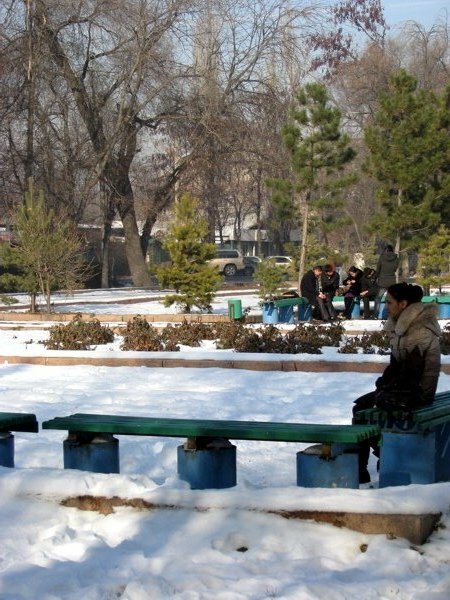


 Bishkek