Muslim clerics ban “New Year” in Kyrgyzstan
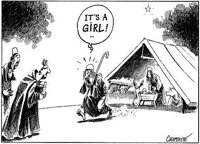
An old joke ...
It’s an old joke but it still brought a smile to my face when I saw the cartoon showing a man in Biblical dress running out of what looked like a tent, (not a stable); a star is visible over the structure. where a woman was bent over a manger with a variety of animals looking on.The man is running up to two men dressed in Middle Eastern garb and crying “It’s a Girl!”
The connotations are not explicit, but it’s clearly a sideswipe at the Christmas story.
Over the years I have seen several versions on the theme including one where the message is “Call off Christmas! It’s a girl!”
Well, it’s been reported in the media that the religious authorities here want to call off New Year. Well, that is, not all of the religious authorities … the Orthodox Bishop hasn’t made a pronouncement. According to the press reports the Muftiat, (the supreme Islamic authority in the country), has issued a fatwah against the New Year celebrations, as the are not related to Islam … oh, and yes, they are too expensive!
The head of the authority, Ravshan Eratove, is reported as saying, “This New Year is not a religious holiday. It is not related to Muslims at all,” adding that only Eid Al Fitr, (known here as Orozo Ait and is a holiday – marking the end of the Holy month of Ramadan), Eid Al Adha, (known here as Kurman Ait and is a holiday – commemorating the willingness of Abraham to sacrifice his son Isaac), and Jumah (Friday prayers) are the only holidays in Islam. “Only those are our holidays. The rest is not about Islam,” he said, and so they have called for the ban, urging Muslims to ignore the holiday altogether.
As an aside: I didn’t realize that Friday prayers constituted a holiday.
Although most of the articles I saw reporting the news were on Islamic sites – it was picked up by Jewish News One who posted a brief report on youtube:
He has a point … New Year was the biggest holiday celebration in the Soviet Union and Kyrgyzstan has continued the traditional celebrations, fireworks, parties (complete with Vodka and Sovietskoye Champagne).
Indeed, it seems to be in keeping with the content of several Muslim websites I have seen, such as here:
Many Muslims have been led astray by the dazzling attractions of the enemies of Allaah, especially the Christians with their major festivals such as the celebration of the birth of the Messiah (peace be upon him) – i.e., Christmas – and the Christian New Year. …
This obliges us to discuss the rulings on the festivals of the kuffaar, how the Muslim should deal with them and how they should differ from them – which is one of the basic principles of this pure religion of ours. Moreover, we need to know some details about their festivals and rituals so that we can avoid them and warn others about them. …
Throughout their history, the Muslims have suffered from the problem of being influenced by the rituals of others through mixing with them. This prompted the imaams (scholars) of Islam to warn the Muslim masses against imitating others in their festivals and rituals. …
It is a great problem that Muslims fall into observing some of the rituals of the disbelievers without realizing that this is part of their rituals and unique customs, which we have been commanded to avoid because it is an abomination and misguidance. …
Eid al-Adhaa came and went, and the Muslims in that country offered their sacrifices. Then when Christmas and New Year approached, preparations began to celebrate them. When Christmas and New year came, they were official holidays in that country, and there were lavish parties and promiscuous soirees. Foremost among the people celebrating were the leaders of the socialist Baath party whose joy at the Christian festivals made them forget the needs of the poor, hungry and naked, whose plight they only remembered at the time of the Muslims.
… and so on.
This isn’t the first time they have made such a call. I recall that they also called on Muslims to ignore St. Valentine’s Day in February, (which is not a holiday – but is marked by many young people) – as for that matter did Hindu fundamentalists in India upset by the continuous encroachment of Christianity on traditional society. There was also some controversy over Halloween, but that’s not particularly marked here.
They didn’t seem to have much of an effect back then and I wonder if the present call will have any greater effect.
I am intrigued, however, why other holidays haven’t come in for similar treatment. If the only Muslim holidays are Orozo Ait and Kurman Ait, (and Jumah), then I presume that devout Muslims shouldn’t celebrate and commemorate the others … such as
- Orthodox Christmas … it’s understandable that that’s not a Muslim holiday – even if the Muslims do respect Jesus as a “prophet” … however, it is not banned and Muslims are not urged to ignore the holiday altogether; most of them, for example, still take the day off.
- International Women’s Day in March, International Workers Day in May, Anniversary of the October Revolution in November, (that phrase, also, always brings a smile to my face) … ”socialist” holidays … they are not banned and Muslims are not urged to ignore the holidays altogether; most of them, for example, still take the day off.
- What could be considered as “National” holidays, like Defenders of the Fatherland Day in February, Constitution Day in May, Victory Day in May, Independence Day in August, are not banned and Muslims are not urged to ignore the holidays altogether; most of them, for example, still take the day off.
- Norus, in March – which is celebrated throughout the Muslim world even though it’s origins lie in Zoroastrianism is not banned and Muslims are not urged to ignore it altogether; most of them, for example, still take the day off.
Even so, the argument does seem familiar. Christmas, after all – as the Jehovah’s Witnesses have been telling us for years – has nothing to do with the birth of Jesus … apart from being the occasion when we choose to commemorate the event. Now it seems that everyone is climbing on board the bandwagon to acknowledge the fact.
Many of the traditions that are associated with Christmas were either pre-existing Pagan practices, (like Yule logs and decorated Christmas Trees), which were simply adopted and adapted by the Church … or are later inventions, (like Christmas Cards and Pantomimes). Even some of the details of the basic Biblical story are “up for grabs”:
- He almost certainly wasn’t born in December, (but probably sometime in June, at least, that is, according to some astronomers);
- He may not have been born in Bethlehem, (or, at least, not the one which houses the Church of the Nativity which is located in the Biblical province of Judea … but possibly in the one in the Northern province of Galilee – just a few miles from his hometown of Nazareth);
- He wasn’t born in the year O (BC or AD) … but probably some years before that;
- There’s only reason for thinking there were three Kings is because there were three gifts, (Gold, Frankincense and Myrrh) … and they probably weren’t Kings but Magi - wise men, probably Astrologers;
However, Christian Churches, generally, don’t call for a ban on the celebrations and urge their adherents from taking part. It is true that Oliver Cromwell did try to ban Christmas in the days of the Commonwealth even, apparently, going as far as making the consumption of Mince Pies on Christmas Day illegal … but, on the whole, these “traditions have become absorbed into the culture.
According to the press reports, Eratov also went on to say that the money spent on celebrating the New Year could be put to better use such as helping children and the poor and, once again, he does have a point.
It is also not a new argument … there was, for example, the dispute between Jesus and Judas Iscariot mentioned in the Gospels about the expensive oil used by Mary Magdalene as a balm which, Judas said, could have been sold and the money used to help the poor, and when Jesus is reported as replying that “the poor will always be with us”. The traditional view of that particular spat is not that Jesus was hardhearted, turning his back on the poor, but that it was a question of choices … or priorities.
It seems to me that the money which people spend on the celebrations is actually their money, to dispose of as they choose – especially if they have already fulfilled their religious obligations with regard to almsgiving. If they choose to spend it on parties and fireworks, then it’s up to them. Although, I suppose it is true that good Muslims shouldn’t be drinking Vodka and Sovietskoye Champagne … but the rest is down to them.
Also, it seems to me, there is no reason to believe that if they didn’t spend on celebrations that they would in fact use it to give to the poor.
What’s more, I find it odd that other celebrations aren’t likewise criticized for being extravagant. It’s true that New Year, (like Christmas back home), is an extreme example … boxes of chocolates given as presents on International Women’s Day, for example, don’t come anywhere near as expensive. Some of the other holidays are celebrated in an extremely modest fashion.
The two Muslim festivals, Orozo Ait and Kurman Ait, and also Norus all have an element of almsgiving built into the traditional practices … but the festivities can be elaborate … and expensive.
More to the point, I can’t say that I have noticed any particular complaints from the Muftiat about the elaboration and expense involved in family celebrations, (Tois), especially weddings and funerals. I have heard complaints from politicians, notably both former Presidents Akaev and Bakiev – not to mention several deputies who have promoted Bills in parliament and measures taken by several councils in Southern Kyrgyzstan to limit the amount people can spend. Indeed, Tajikistan already has such a law on the stature book. On the other hand, these measure are designed more in order to avoid families getting into financial difficulty and debt, than for humanitarian reasons – that the money could be better used in helping the poor.
Over the years, I have been to several such family gatherings including a Tülo Toi, a special feast given by someone who has escaped misfortune, (for example, being beaten almost to death by robbers but having recovered), as a “sacrifice” , a thanksgiving to God for having put the misfortune behind them.
There are other Tois as well … all of them can get out of hand and be extremely elaborate … and expensive … although, to be fair, some of them also have an element of almsgiving involved.
However, I am fairly sure that I have never seen these criticized as extravagant – where the money could be put to better use in aid to the poor.
How successful the fatwah will is anyone’s guess. Some of the more observant Muslims may heed the call … , “if they said it is not allowed according to Sharia then it is not allowed,” one person is quoted as saying.
Apparently there are some people who disagree enough to allow themselves to be quoted in the press … One of them, (judging by her name, a Russian – so technically not affected by the fatwah), criticized the Muftiat saying, “They think people will eat non-Muslim food, or go out to the street to light fireworks and cause harm to each other, They see only bad things about the New year. But I think you can find a lot of good things about the New Year and make a very happy New Year celebration.
All the signs I have seen, however, seem to suggest that the majority will let it pass by and continue to ring out the old and ting in the new … just as they always have.
_______________________________________
Incidentally, My thanks go to a blog post on Kloop for the reminder that there are some people who will be working on New Year’s Eve and New Year’s Day, whilst everyone else is partying … and not all of them will be devout Muslims or Jehovah’s Witnesses religiously ignoring the festivities.
Some of them will be “essential workers” providing vital services, others simply fulfilling their normal shift rota. Occasionally someone has their own reasons for wanting to work that night: one of our employees, for example, always used to volunteer to work on New Years’ Eve and would swap shifts with others, so that he could be free to attend his daughter’s Birthday part on January 2nd. Others may well be taking advantage of the fact that they are entitled to double pay for working on a holiday.
- Emergency Services will operate continuously – incidentally, it seems that they get no “bonus” for working over the holidays;
- The two largest supermarket chains in Bishkek will work on both days: 31st December and 1st January, although some may have shorter opening hours – even those who normally work “around the clock”;




 Bishkek