Some Inspiration for New Year’s Resolutions

An inspirational poem
On Saturday I chose as my theme my weekly postcard Kipling’s inspirational poem IF …
Every Saturday, I write a review of the weeks news and events and send it out by email to a circle of relatives and friends, partners and clients – past and present – and a wide variety of other people who have to be included in the mailing list.
I try to find a theme each time, often associated with some thing in that news, a topical event such as the Olympics, a Commemorative Day or an historical anniversary. Sunday saw the anniversary of Rudyard Kipling birth … which prompted the choice of IF …
As I said on Saturday, Kipling is a somewhat controversial figure … a paragon of the British Empire, which is an image that does not exactly fit the twenty-first century. Despite this his stories still maintain an interest and are well read to this day … even if they are not exactly read these days, many of them have become a part of the cultural heritage of the English Speaking world … and beyond.
I am often amazed, for example, that many people here are very familiar with the stories of Mowgli and Riki Tiki Tavi … especially as he is often seen as the epitome of the British side playing the Great Game, the stragegic rivalry and conflict between the British and Russian Empires for supremacy in Central Asia. Indeed, it can be said that Kipling brought the Great Game into the public’s consciousness with his novel Kim.
His own story is pretty remarkable in it’s own right.
He was one of the most popular writers in England at the end of the nineteenth and beginning of the twentieth centuries, becoming the first British write to win the Nobel Peace Prize. He turned down both the post of Poet Laureate and a knighthood.
Although his father was a Professor of Sculptural Architecture in Bombay, (nowadays, Mumbai), and his mother a society lady, not to mention the fact that he could count the painters Edward Burne Jones and Edward Poynter and future Prime Minister Stanley Baldwin among his relatives, he was not exactly “born with a silver spoon in his mouth“. At the age of five, he and his younger sister were sent back to England for their education; a common practice at the time. They were boarded with a family in Southsea, Portsmouth, for the next seven years … but it was not a happy time. In his autobiography he resembled it to torture.
After school, it was decided that he wasn’t “intelligent enough” to to gain a scholarship to Oxford University and as his parents lacked the financial resources to enable him to continue his education, his father obtained a job on a newspaper for him in British India, in Lahore, (which is now in Pakistan).
He worked on several newspapers before before being sacked over a dispute, and started travelling – to Burma, Singapore, Hong Kong, Japan and the States and Canada, before arriving back in Britain. Later, he settled in America with his family but sensing an anti-British sentiment he chose to return to England. Later he also traveled to South Africa.
Reading his biography, one gets a sense of watching an episode of Dr. Who … you never know who is going to crop up next, … littered, as it is with famous names such as Mark Twain, Cecil Rhodes, Henry Rider Haggard, Robert Baden Powell to mention just a few.
He lost a son in the First World War, aged just 18, in the Battle of Loos. Although he had supported (and encouraged) his sons enlistment, after his death he penned the two lines which serve as an epitaph:
If any question why we died
Tell them, because our fathers lied.”
He continued writing well into the 1930′s but was already past his peak – his time had come … and gone. He died, at the age of 70, on 18th January, 1936.
For the record … here is Kipling’s poem IF …:
IF you can keep your head when all about you
Are losing theirs and blaming it on you,
If you can trust yourself when all men doubt you,
But make allowance for their doubting too;
If you can wait and not be tired by waiting,
Or being lied about, don’t deal in lies,
Or being hated, don’t give way to hating,
And yet don’t look too good, nor talk too wise:
If you can dream – and not make dreams your master;
If you can think – and not make thoughts your aim;
If you can meet with Triumph and Disaster
And treat those two impostors just the same;
If you can bear to hear the truth you’ve spoken
Twisted by knaves to make a trap for fools,
Or watch the things you gave your life to, broken,
And stoop and build ‘em up with worn-out tools:
If you can make one heap of all your winnings
And risk it on one turn of pitch-and-toss,
And lose, and start again at your beginnings
And never breathe a word about your loss;
If you can force your heart and nerve and sinew
To serve your turn long after they are gone,
And so hold on when there is nothing in you
Except the Will which says to them: ‘Hold on!’
If you can talk with crowds and keep your virtue,
Or walk with Kings – nor lose the common touch,
if neither foes nor loving friends can hurt you,
If all men count with you, but none too much;
If you can fill the unforgiving minute
With sixty seconds’ worth of distance run,
Yours is the Earth and everything that’s in it,
And – which is more – you’ll be a Man, my son!
_______________________________________
Last week I came across another inspirational poem – but authorship of this one is not known … it was attributed to Anonymous.
It was posted on the Facebook page of a group called Wipe Out Suicide, which has almost 65,000 “Likes” … (andplease don’t misunderstand that … No!, … I am NOT considering anything like suicide … one of my Facebook “friends” reposted it). It struck me as a particularly good message … and not just appropriate for those desperate enough to consider committing suicide … but with a much wider import which I thought I would share it with you … even though I am not very fond of poetry:
When things go wrong, as the sometimes will,
When the road you’re trudging seems all uphill,
When the funds are low and the debts are high,
And you want to smile, but you have to sigh,
When care is pressing you down a bit,
Rest! if you must; but don’t you quit.
Life is queer with its twists and turns,
As everyone of us sometimes learns,
And many a failure turns about
When he might have won had he stuck it out;
Don’t give up, though the pace is slow;
You might succeed with another blow.
Often the goal is nearer than
It seems to a faint and faltering man,
Often the struggler has given up
When he might have captures the victor’s cup.
And he learned too late, when the night slipped down,
How close he was to the golden crown.
Success is failure turned inside out;
The silver glint of the clouds of doubt;
And you never can tell how close you are,
It may be near when it seems afar;
So stick to the fight when you are hardest hit;
It’s when things seem worst that you mustn’t quit.
I have to admit that it has nothing to do with Kyrgyzstan – although it does sum up my feelings every time I enter into a dispute with the authorities, (especially the Tax Inspectorate), or try to encourage members of an association to be more actively involved in its activities.
I also thought that it made quite a nice basis for a resolution as we head into a new year.
_______________________________________

An interesting idea for a New Year's resolution!
Incidentally, it’s not another poem but on their Facebook page I saw this, which I thought was an interesting idea and good advice for a New Year’s Resolution …
I think I am going to do it … I’ve already selected a jar – no, not a Marmite jar – I’m hoping that will be too small.
Perhaps, during the year, I’ll be able to write a postcard about some of the notes and next year review them for you.
Why not give it a go!






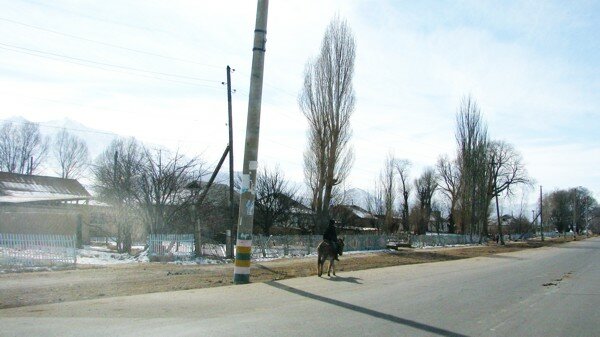
 Bishkek