The sky at night
I returned home last night after another surreal evening playing Petanque and settled down with a cup of coffee to watch BBC World before dropping off to sleep. To my amazement, there was an announcement that the next programme would be “The Sky at Night”, presented by Sir Patrick Moore.
Broadcast once a month, the Sky at Night has been running since April 1957 and Patrick Moore has hosted all but one episode, (which he had to miss due to illness), making it him world’s longest running TV programme presented by one person, and making him the longest serving television presenter.
This might seem odd given that it is a programme dedicated to what must be a fairly minority interest group. However, it was launched on its initial three month trial run at an opportune moment. It was in October 1957 the Soviets launched the first artificial satellite, Sputnik 1, into space and captured the imagination of people all over the world. The programme has spanned an era which has contained a large number of such events … and the monthly half-hourly reports always seemed to have something important to say and went on to inspire many people.
Now, it is some years that I have seen “The Sky at Night”, but I well remember watching the programme in my youth. To be honest, I cannot say that Astronomy was a great interest of mine as a child, and I often found that the detail contained in individual items sometimes went “over my head”, but I did have a passing interest.
This was fed to a certain extent by one of my Maths teachers, who was a bit of a fanatic on the subject. He could always be relied upon to digress at the slightest opportunity … which was something we took advantage of whenever we found the subject of the lesson a little boring. It was quite common for someone to say that they had seen something strange in the sky the previous evening and to ask what it might have been. Red Giants and White Dwarfs proved to be more interesting that quadratic equations on a dreary Thursday afternoon.
One of my friends was very keen on Astronomy and started an Astronomy Club which met every Tuesday lunchtime, and although some people came along simply to get out of the rain, or for something to fill-in time, I did find the talks, the films and so forth, interesting. The Sky at Night would always provide us with a topic …
One year, for the school open day we prepared a display to show what the Plough (the Big Dipper) in the Great Bear constellation (Ursa Major) would look like from different positions in space … what Captain Kirk and the crew of the Starship Enterprise might see after they emerged from Warp Drive several parsecs from Earth.
Patrick Moore, (just Patrick Moore at that time – he didn’t receive his knighthood until 2001), was not just the presenter of the show – he was the star of the show … and the butt of many impressions, most of which made fun of his eccentric, “larger than life”, character; wild mop of hair, and galloping chatter littered with incomprehensible names and terms uttered with obvious and infectious enthusiasm for his subject.
So as the striking chords of Sibelius’s “Pelléas et Mélisande”, the show’s theme tune ushered in the latest episode, I settled back to wallow in nostalgia and partake in something reminiscent of my youth.
You can imagine my surprise, therefore, when Patrick Moore came on screen. Remember, as I said, I haven’t seen the programme for many years – and so I was in no way prepared for what I saw and heard. Sir Patrick Moore was still presenting the show, but the passage of years have taken their toll … he is much bigger than I remembered, filling the screen not just with his character, but with his torso. Instead of sitting upright or leaning forward as I remembered him, he was laid back in an armchair. His voice was no longer as commanding and dramatic as it had been. Oh yes, the old enthusiasm was still there, there was still a gleam in his eye and a spark in his performance. He exuded authoritative confidence in his every utterance … and his guests, all renowned and learned experts in their field, seemed to hold him in high regard, with both respect and affection.
The sudden and dramatic contrast between the “then and now” images of this charismatic character brought me up short and gave me much to think about – especially about the vagaries of time and the effects of aging. I wonder what people who haven’t seen for fourteen years might have to say about how I have changed in that time.
One of the other, more pleasant, thoughts that came to mind was of one of the most enduring memories I have of my first visit to Kyrgyzstan, back in 1994 … that of the night sky.
It was the last day, (night), of my visit and at that time there were virtually no flights into and out of Manas airport in Bishkek and so we flew through Almaty, about 250 kilometers away, over the border in Kazakhstan. The flight left in the early hours of the morning, so after supper we got into a hired car and settled down for the four hour drive over the mountains to the North and then along the foothills.
During the Soviet period, the border was basically just an administrative one. On one side was the Kazakh SSR and the other the Kyrgyz SSR – both of which were constituent republics of the same country – the Union of Soviet Socialist Republics, or USSR. Although in 1994 it had become an International border with border crossing points, passport control and Customs procedures, the crossing was very simple, virtually free of any formality. We just drove up to the border and they waved us through.
That doesn’t mean, however, that our passports weren’t checked … on the contrary. There were several points on the journey where the vehicle was stopped by the GAI – the State Auto Inspection, or Traffic Police – who asked for our passports and looked us over. Coming from Britain, this struck me as quite odd, and to be honest, unnerved me a little.
These days the procedures are much more stringently enforced and it is possible to end up in a long queue waiting for the officers to scrutinize everyone’s papers, although the GAI are not so obvious.
After crossing the border, which is only about 30 kilometers from the Bishkek city center, the road wound its way as it climbed to the Kordai Pass, 1233 meters above sea level. The meandering road was clear as it was summer, but I was told that in winter, when it is covered in snow and ice, it can be quite dangerous. The derelict ruins of cars and buses at the roadside gave ample evidence of this.
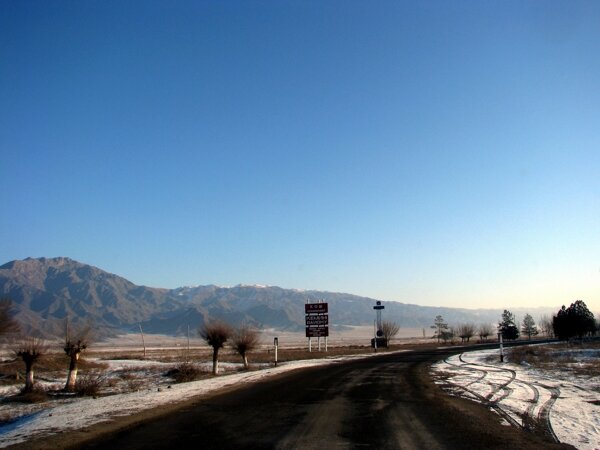
After crossing the pass we descended to one of the GAI check posts and what seemed to be an endless straight road running along the foot of the mountain range … mountains to the right of us and endless steppe to the left. Not that we could really see much as it was pitch black dark … no lights on the road, only distant lights to indicate some village or settlement either on the slopes to our left or way out on the steppe to our left.
Our driver, Sergei, was a former helicopter pilot. There were quite a few of them here at that time as during Soviet times Bishkek Kyrgyzstan had a number of strategic bases, a flying school, (where Presidents Assad of Syria and Mubarak of Egypt had been trained) and several squadrons of helicopters had been based here. As you drove into Bishkek from the airport you could rows of helicopters lined up at the side of one of the airfields not far from the road.
Anyway, after a couple of hours, Sergei stopped the car and asked for a “smoking break”. It seems as if everyone here smokes, although that’s not true, but certainly a lot of people do. The thought of a four hour car journey without a “puff” can be quite a strain for some people. At least he did the professional thing and stopped rather than smoking at the wheel. It was probably time for a break anyway and a rest would help his concentration, so we were more than willing. We had a flask of hot coffee with us and drank a cup … and then stood and took in the scene: the darkness, the silence and the night sky.
I don’t think I had ever seen anything quite like it before. It was a cloudless night and there seemed to so many stars … much more than I had seen at home, and they seemed closer, and brighter. Of course, there was “light pollution” – no streetlights or neon signs to interfere with the view. It was almost a mystical experience. I stood there and counted off the constellations that I could recognise and I remember thinking at that time of Patrick Moore and the “Sky at Night”. I have the same feeling twice since then – once in Ala Archa, in the mountains outside Bishkek one August night when I watched the Perseid meteor shower and another summer night up at Lake Son Kul.
I was quite sorry when Sergei finished his cigarette and we climbed back into the car and continued on our way to Almaty.


 Bishkek