World Television Day
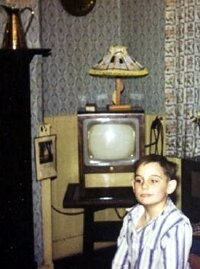
Sitting in front of a proud addition to the family ...
These days I often wonder how we survived without the conveniences of modern day life such as mobile phones and the internet – especially Wikipedia …
Back in 1950’s we acquired something that changed out lives in much the same way – the television set. Like a Russian icon, it was put into a corner of the room and all chairs turned to face it … it was quite bulky but the screen was quite small, the picture was in black and white and was quite often grainy, there was only two channels, (the BBC – the British Broadcasting Corporation and ITV – Independent Television … it was some time before BBC2 and Channel 4 were launched … yet alone the host of other channels that now grace the airwaves), but it still assumed a massive role in our lives.
Today, 21st November is World Television Day – established in 1996, “in recognition of the increasing impact television has on decision-making by bringing world attention to conflicts and threats to peace and security and its potential role in sharpening the focus on other major issues, including economic and social issues”. According to the UN web page dedicated to the day, it is not so much “a celebration of the tool”, but rather “the philosophy which it represents”, as a symbol of communication and globalization in the contemporary world.
At about the same time as my family got our first television set, Kyrgyzstan was also introduced to television. Although television broadcasting had begun in the Soviet Union as early as 1938, it was originally only to be found in Moscow and Leningrad. Apparently the first broadcast service in what is now Kyrgyzstan started only in 1958.
The station KTR, (Kyrgyz Tele Radio), was launched in the same year and programmes were broadcast in Russian. The channel still exists and is still operated by the State but since then it has accumulated a number of competitors. According to news reports there are about 100 TV companies officially registered in Kyrgyzstan, but “only a half of which are working”. Currently, there are something like eight state owned television stations and twenty private ones, most of which are based in the capital, Bishkek and the Chui region.
In the past there have been concerns expressed about the ownership of many of the privately owned and run stations – especially as the owners seemed to be people with connections to government or government figures.
If the early programming was all provided in Russian, that is by no mean s the case now – with several dedicated Kyrgyz channels, especially those targeted at the regions, and others providing two versions of each programme; one in Russian and the other in Kyrgyz. It used to be that you could catch the odd programme in English – but it’s a long time since I have managed to catch one.
Russian channels are transmitted and are quite popular – especially the Premier Channel and RTR.
In Bishkek there are a couple of cable TV providers which offer a range of packages. The basic package offers something like sixty different channels. Whereas these included a variety of foreign language stations, (for example: English, French, German, Turkish, Indian, Japanese, Chinese … as well as Russian and Kazakh in addition to the local channels), these days most foreign channels, (such as Discovery, National Geographic, Cartoon Network and Nickelodeon), are transmitted in Russian language versions – the only English language channel still being transmitted as part of the package is CNN.) Separate packages, however, offer a range of other channels …
Satellite dishes can be seen throughout not just the capital but around the country – but it would be wrong to conclude that many people have access to satellite TV.
Web TV also exists – but mainly for news programmes … such as stan.tv … and there are a wide variety of video sharing sites.
There has been discussion about introducing Digital television, and assistance has been provided by the Chinese, running a pilot scheme in Batken. In theory, Kyrgyzstan has some international commitments which required it to introduce digital TV by the end of 2012 – but it clearly isn’t going to fulfil them.
The stations are licensed and regulated by the government. During the Presidential elections of 2011, there was some considerable controversy when the parliament passed a measure requiring that broadcaster should not transmit programmes from foreign stations without a time delay so that references to the election could be excised. The local broadcasters did not have the necessary equipment and it looked as if the foreign channels were all going to have be blocked – including the popular Russian channels. In fact, the Russians came to the rescue providing the necessary equipment so that most channels could continue to be transmitted.
Coverage can be somewhat limited, particularly in some of the more remote areas and especially in the south of the country but according to some reports, about 99 percent of the population has access to one or more TV channels, 81.6 percent – two or more, 78.4 – three or more channels. Only one percent of the Kyrgyz population remains without coverage of TV broadcasting.
When it comes to receiving the signals, according to official figures there are something like 450 television sets in the country for 1000 people in the population and according to one source that’s some 84% of households.
A survey last year suggested that most people get their news of what is happening in the world through the television.
Some of the Universities offer courses in Television and I think that two of them actually have their own studies and operate a local, campus, station.





 Bishkek